A Complete Guide to Low-Voltage Landscape Lighting
Illuminate pathways and accentuate mature trees without overpowering your night sky. Tips on choosing the right Kelvin warmth.
Landscape lighting is the only improvement that doubles the hours you can use your yard. A patio you can only enjoy until eight in the evening is a patio you use half as much as you could.
Why low voltage is the standard
Low-voltage systems run at 12 volts through a transformer rather than at household current. That single difference drives most of the advantages: cable can be buried shallow rather than in conduit, fixtures can be moved as plants grow, and the safety profile around children, pets and wet ground is far better.
Paired with LED fixtures, the running cost is small enough to stop being a consideration. The real budget question is fixture quality, not electricity.
The techniques worth knowing
Good lighting design is a small vocabulary used well.
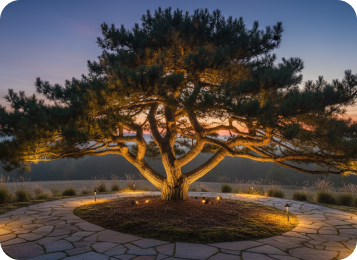
- Uplighting. A fixture at the base aimed upward. Best on trees with interesting branch structure and on architectural features. This is what makes a house look designed rather than lit.
- Path lighting. Low fixtures that wash the walking surface. The goal is a lit path, not a row of visible lamps. Spacing them evenly like runway markers is the most common error.
- Downlighting, or moonlighting. Fixtures mounted high in a tree aimed down. It produces soft dappled light that reads as natural, and it is the most underused technique in residential lighting.
- Grazing and washing. Light aimed across a textured surface like a stone retaining wall to bring out relief, or spread evenly across a flat surface to lift it out of darkness.
- Silhouetting. Lighting the surface behind an object so the object reads as a shape. Effective with ornamental grasses and sculptural shrubs.
The mistakes that make a yard look worse
Too much light. The eye adapts to darkness. A small amount of well-placed light reads as dramatic, while a fully lit yard reads as a parking lot and destroys the contrast that makes lighting attractive.
Visible glare. If you can see the bulb from the patio or the kitchen window, the fixture is aimed wrong or needs shielding. You should see the effect, not the source.
Inconsistent color temperature. Mixing warm and cool LEDs in one yard looks like a mistake because it is one. Pick a temperature and stay with it. Warmer tones generally flatter stone, brick and plants.
Lighting everything equally. Decide what the focal points are and let the rest fall away. A landscape with three things lit well beats one with fifteen things lit adequately.
Montana-specific considerations
Snow changes everything. Fixtures at grade disappear under accumulation and get caught by shovels and plows, so placement has to account for where snow lands and where it gets piled. Fixtures along a drive or walk need to sit outside the throw zone or be easy to find and reset.
Snow is also highly reflective, which means a lighting scheme calibrated for summer can feel glaring in January. Systems with adjustable output handle this better.
Finally, winter is when you look at your landscape from inside the house most often. Lighting designed only for people sitting on the patio misses the season when it matters most.
Design it before you buy fixtures
The temptation is to buy a kit and place lights where they seem to fit. The better sequence is to decide what you want to see at night, from which vantage points, and work backward to fixtures and placement. That approach usually needs fewer fixtures and produces a far better result.
We design and install landscape lighting in Billings, MT as part of the overall plan, which means fixtures get coordinated with patios, retaining walls and planting instead of added afterward. Request a free consultation for a lighting plan.